
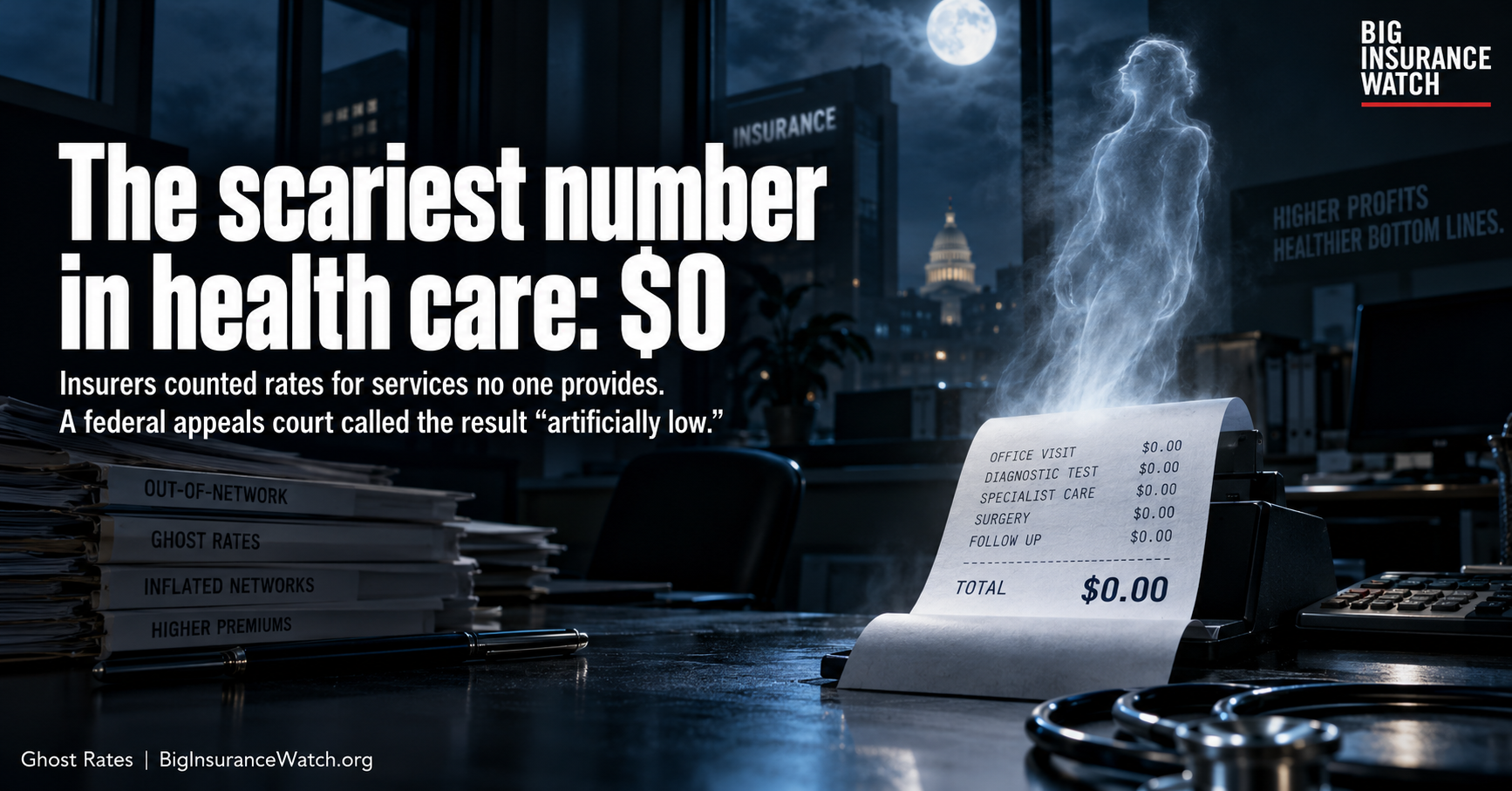
Last week we wrote about ghost networks: insurance directories full of doctors who are not really taking patients. This Halloween, meet their cousin, ghost rates.
Under the No Surprises Act, an insurer's "qualifying payment amount," or QPA, is supposed to reflect the median rate it actually pays in-network providers for a service. That number matters. It helps set what patients pay out of pocket, and it is the starting point when a payment dispute goes to a neutral arbitrator.
For years, insurers counted rates for services a provider never actually performs. A contract might list a price for a procedure that doctor has never done and never will, sometimes as low as $0. Those phantom prices went into the median and pulled it down.
In August, the full U.S. Court of Appeals for the Fifth Circuit ended the practice. The court found that ghost rates produced "artificially low QPAs" and struck them from the federal formula.
Federal auditors keep finding problems, too. CMS found Aetna of Texas calculating air ambulance QPAs from paid amounts instead of contracted rates. This month, auditors found CareSource substituted "usual and customary" rates in all 952 QPAs they sampled. Neither audit carried a financial penalty.
Why does this matter now? Because the newest proposals in Washington would make the insurer's number the final word. One bill would end arbitration and pay out-of-network care at the insurer's 2019 median rate plus inflation, with no neutral review. A think tank proposal would cap arbitration awards near the insurer's in-network rates. So when you hear that arbitrators award "four times the QPA," ask a simple question: four times what? Some of those benchmarks were built in part on rates that never existed.
The answer is not to hand the pen to the insurer. Keep the neutral referee. Make the insurer's numbers honest. And make sure that when an arbitrator rules, the award actually gets paid, which is what Rep. Greg Murphy's bipartisan No Surprises Act Enforcement Act (H.R. 4710) sets out to do.
Patients pay real premiums. They deserve real networks and real rates. Happy Halloween.
Sources
Texas Medical Ass'n v. HHS (TMA III), U.S. Court of Appeals for the Fifth Circuit, en banc, Aug. 11, 2026
CMS QPA audit reports: Aetna Health of Texas (2024) and CareSource (Oct. 2026)
H.R. 10788, Lower Premiums, Faster Payments Act (Pallone, Oct. 2026)
Paragon Health Institute, "Fixing the No Surprises Act" (Sept. 2026)
H.R. 4710, No Surprises Act Enforcement Act (119th Congress)